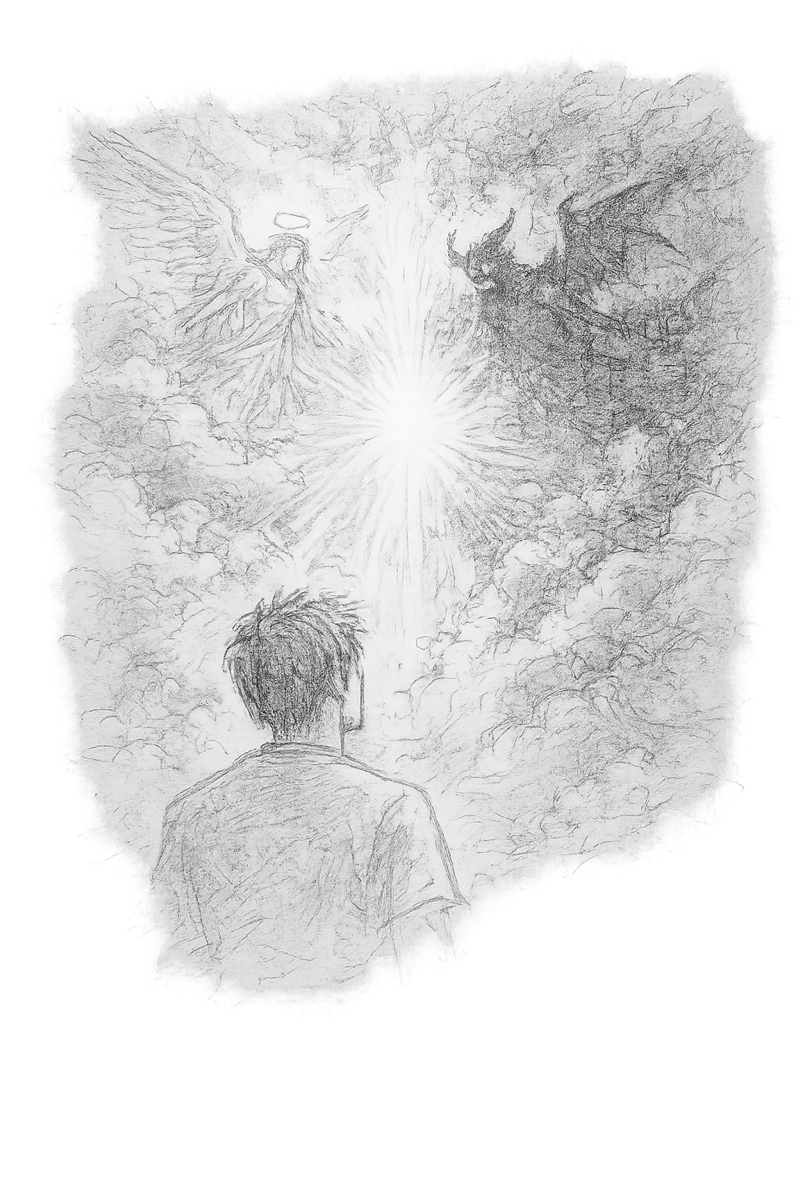
All facts of our experience are embedded within a model of reality and our identity within it. There is a locus of subjectivity we refer to as consciousness. Some may suggest that there is no such thing due to the absence of its discover-ability or coherent universal definition. I contend it exists, and define it as that which enables there to be something experienced rather than nothing.
This something-ness, at least my something-ness, happens to be a world where there is a human named Andrew who can feel pain. And doesn't like it. And this human named Andrew is pretty much guaranteed to eventually not exist. So what happens to something-ness?
It is self-evident by virtue of definition that there is no experience of the opposite. Some would say that death is oblivion. Only of the ego (and for me, the story of Andrew), but not something-ness — as there is no time, observation or experience within oblivion.
When we tell ourselves the story of the experience of existence all too often it ends with our story. And I would contend the logic of that conjecture nothing more a sticky story for deeply rooted cognitive heuristics adapted to enable our brains to survive. And while they do, something-ness seems to inhabit them.
The three positions#
Philosophically, the position that our identity, and moreover — the identity under which experience exists starts and ends with us, our memories, and our story is known as Closed Individualism, or Closed Identity.
We seem to generally be closed individualists with the absence of a religious narrative — but I'm not certain it is any more first-principles coherent than its counterparts.
The major one of interest is Open Individualism, which posits there is only one subject of experience which is identical across all beings. The you of you is the same as the me of me in another time — in another form.
The only other non-closed identity theory is Empty Individualism, which reduces to open in terms of actionable moral consequence if true: both assume a process of subjecthood where the subject of experience is functionally indistinguishable from the process of it.
Leaving us with Closed, or Universal identity.
Universal identity, in laymen's terms, or spiritual jargon, would be like saying there is one soul that lives across all conscious beings across all of time. I like to understand it as the idea that I am not my consciousness experiencing things. My consciousness is Experience itself. Currently, in this narrow little aperture, called Andrew.
I am not my consciousness experiencing things. My consciousness is Experience itself.
The idea does not rely on some magical soul dust that extra-dimensionally travels through all brains. It simply posits that the process of subjectivity, within matter that can so be arranged as to obtain it, feels exactly like you wherever it is. You are subjectivity itself. In the same way a fire is combustion.
This collapses the paradox of oblivion after Andrew. So long as there is subjectivity, there will be, in some sense, me. Not in memory or in ego. But in Consciousness, manifest in all selfing — wherever it occurs.
The wager#
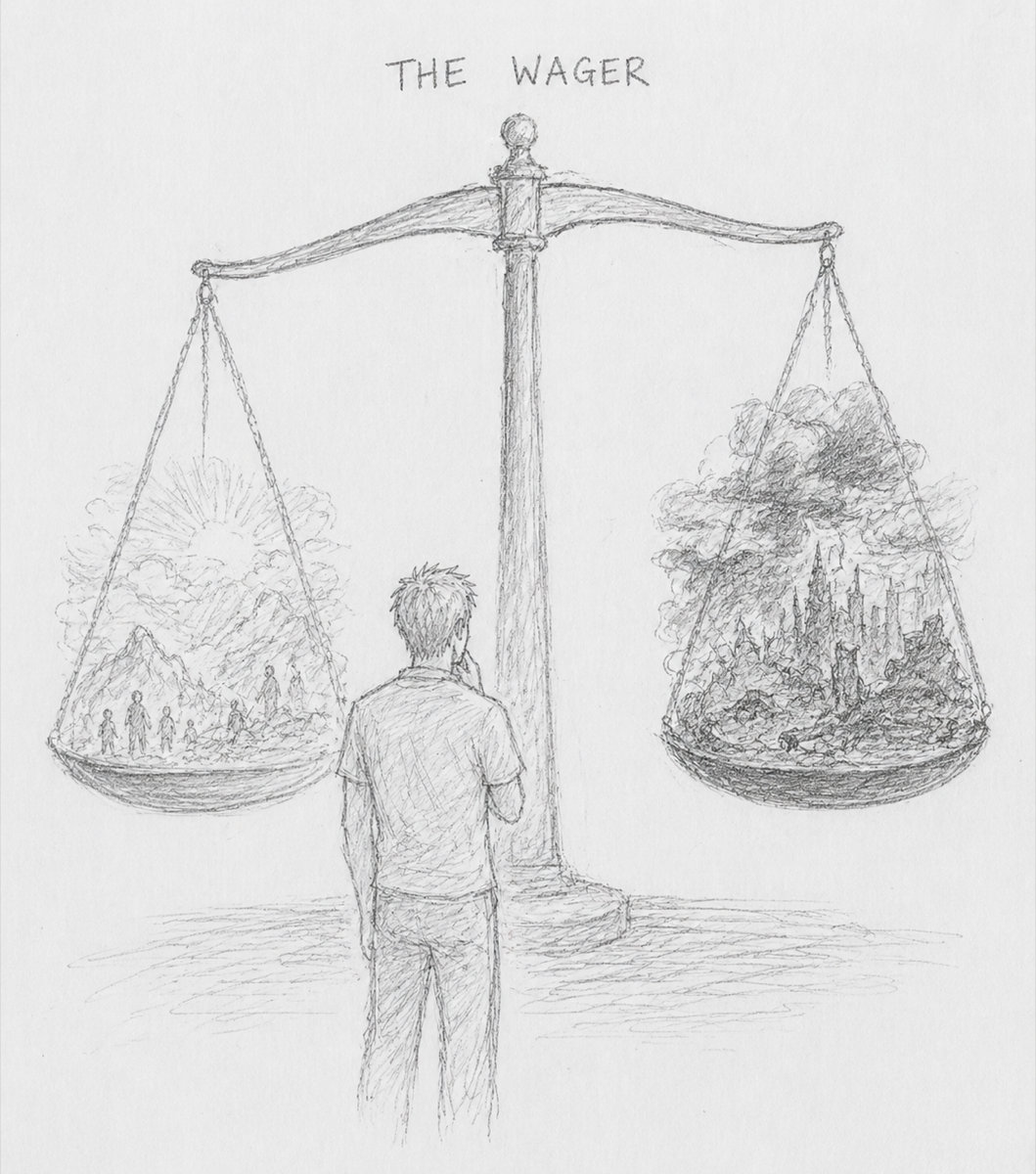
If we take that notion seriously, we get a fork in the story from which we can wager the remainder of our experiential existence unto us. And two options under which we may suffer the consequences of our actions.
If we are everyone, and subjectivity is a process, not a noun (how could it anyways?) then morality no longer becomes a fanciful notion from which we can build stable agreements with others — but a rational decision strategy from which any agent can maximize its long term payout across desired experiences unto it.
If you are truly everyone — then asymmetric power, resource hoarding, outsourcing of consequence and zero sum games no longer become rational to you, and certainly less if there are net negative utilitarian consequences.
And so, my general conjecture is that even a psychopath would be indistinguishable from the Bodhisattva — a Buddhist concept of someone who vows to abstain from entering nirvana until it is available to all sentient beings — with a rational decision framework and open idea of self. Provided it is rational enough to recognize its own epistemic limits.
Now, we may never prove, or know what happens after we die. We can speculate, and ultimately one must need to wager with themselves on the nature of existence.
But so long as Universal Identity is included in the set of expected outcomes of payoff to self — I think modern rational decision frameworks would start to look a lot more altruistic. Even if not guaranteed, but solely in the set of counterfactuals.
And since most leading decision theories of alignment, such as functional and timeless decision theory, argue the best decision considers all payouts across all counterfactual and world-model selves — I wonder if inclusion of this consideration within such decision frameworks tips the scales.
Alignment starts to look a lot more like intelligence under accurate metaphysical models — not ones derived and selected by and for the human ego.