Don't Flinch#
We sat in the tent under the yellow light of a single lamp, while the brisk wind blew and she spoke in crackling whisper. "The Karaoq are here. And always were", she gasped. Staring intently, down at the light, then at each of our faces.
"As long as man told stories. They exist in any place they choose. Like opening a zipper, one long black and pointed foot will slither out from their place and plant in ours. Then another. They would smile, she said. Always. Smiling jaws of mashed knives as the hot black leaks and drools. With white eyes. Great smiles. And sparkling teeth. They would stretch and wind and could hop back and forth in a room like flies in a jar. And they spoke. Oh how they spoke. 'You are a special one!' They would cackle and dance towering over you then shrinking and shape-shifting into a crying baby on the floor looking like it is dying, dying. WHO is going TO THE FAIR they would sing! You! You! You! As they popped their long blackened bodies into your face so close you feel their hot warm breath. And when they got you. They made a great spectacle. Wrap you up in a twirled web snapping you to the wall. Dancing, prancing and flapping their arms. Then they would tear you apart. Never to eat, no. They simply amused in the visceral. The more you wanted out of restraint the more they kept it squeezed while snapping bones and playing your nerves like fiddle. They were the great bane. Demons and monsters. Until one day, in a tent like this one, one unzipped the hatch and came in. A blind and deaf woman, sat and it played its games on her. But she never saw, and it stayed and danced around her as all who fled would say. All night. Then it was learned that for all they did they could not touch you. Or these things in this place unless you would avert your gaze, from your things, from your business and flinch. All could see them. But if you flinched they would take you. If you were a witness to that being taken and so spoke of it — they would take you. And many men died from The Karaoq, who exist across time. Some didn't. Those who played their game of the world while the tall and slender mouths breathed on them next to their face, waiting — you to only miss one beat. Dancing, mocking. Beaming back and forth across the room. ANYTHING TO MAKE YOU LOOK. And if you did. Worlds merged. You were theirs. Over time only those of us who would not look, steadfast in sublimation of our fear of them, continued. And in our children, and their children, over time — the human mind changed to not see the Karaoq at all. Save for a few. Who would come along, and see them, still there, dancing and screaming for them."
I then heard an unzip of a tent. And looked at the latch in the place we were cuddled and it was closed. Then, I felt hot breath on my face.
"DON'T flinch" She whispered. And was ta—
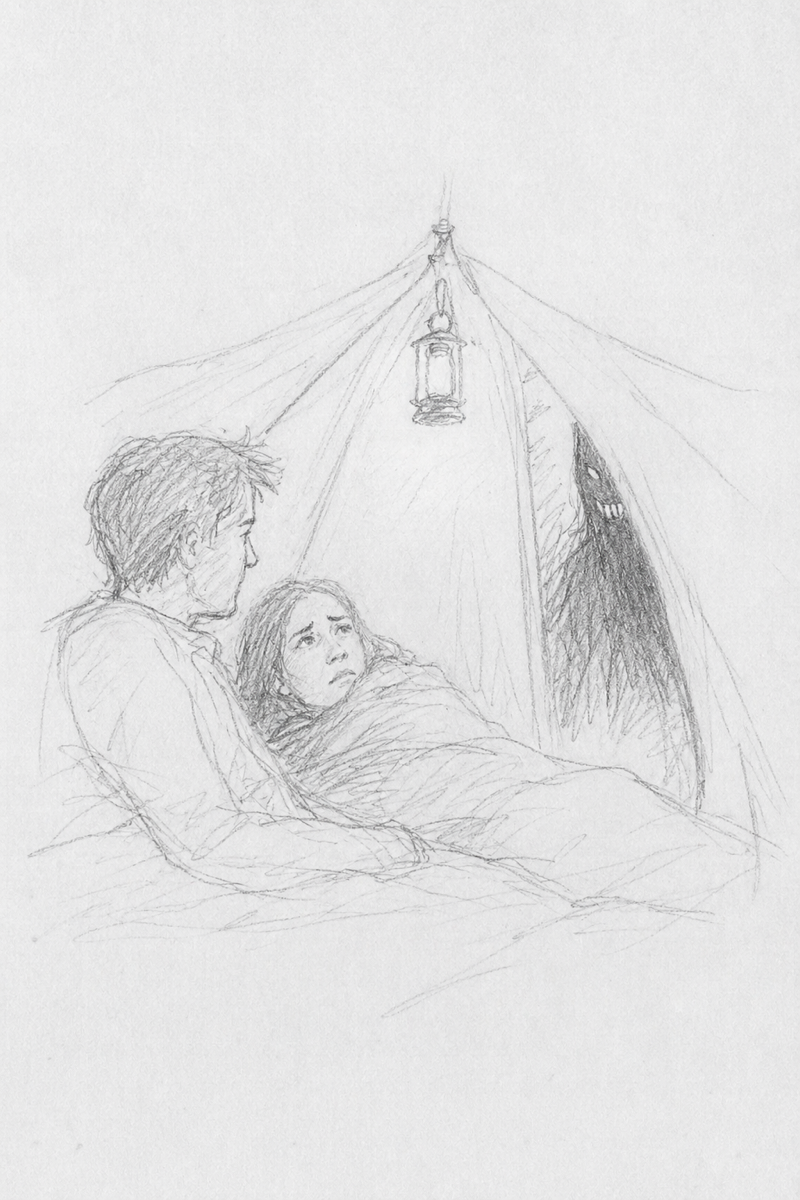
If the person in the above story sensed on some level at that final moment, that there was a Karaoq next to them. Should he look? Perhaps we cannot recognize evil purely as such. For the same reason no-one lives to know a Karaoq. As if they did exist, one could necessarily never know and prove it. They would exist in the same space as our own thoughts. Yet still, out there.
I share this koan because it speaks to what I have learned about the truth of good and evil and how morals are made. I think that normative truth would exist in such a world with Karaoqs as a quasi-ontological truth. For the learned rule to not make a Karaoq real is the most precise description one could ever obtain about such beings, and whether they exist, or not.
Since there are no humans who have engaged with a Karaoq — they only exist as concepts unto us, thoughts, like Good and Evil, which define our behaviour in ways that we could never explain. But beyond the realm of what we could possibly know or prove — the Karaoq do exist. But only seen as shadows in the walls of our thoughts. Like the idea of suicide. They exist in way that we can't confirm.
This led me to question if the apple of Eden represents human pride growing so much as to elect that we can handle testing such truths like reacting to a Karaoqs. For to not choose to look, may be the dividing line between intelligence and wisdom. This analogy makes the tale of Genesis now makes sense to me. Not as a truth but as a survived description of how we ought to be.
Our current times have us absconding the traditions of before in order to herald of more precise truths and descriptions of what is. Stagnation is lamented. Stasis abandoned. Often so that we may see the truth of our own potential or live as kings. Yet such pursuits may also carry us to the brink of annihilation. Exactly for the reason so described by sustaining memes like the story Genesis. Our pride, in ourselves, for having overcome the mythos of our forefathers from which we felt so shackled — yet under which we sustained for so long.
With artificial intelligence, nuclear weapons, synthetic viruses and bio-technology we walk the razors edge of looking a Karoaq in the face. It seems that in the shift of worship from theology to science, progress, celebrity, and power, our highest virtues have shifted from those told to us by The Bible, Quran and Vedas to one of man's overcoming, and the power we now have over nature as the result of finding more descriptive and precise truths through Science. With that power comes pride, and with that pride comes the decision to deride old norms in lieu of a new and accelerate set of tools — along with the principals that discovered them.
I certainly do not sanction all old norms, but I do reason that new norms have not yet faced the same survivability tests for humans as a whole as that of the old. And I am asking under what form of inquiry can we truly qualify their good or badness? For using truth in of itself as the final arbiter may be an annihilating measure, as it would be in a world with Karoaqs.
The absence of change, innovation and growth is near synonymous with badness under an accelerating capitalist narrative — largely as a result of technological advances which support a feedback loop of further inquiry and power reification. But is such a narrative wise?
To this topic I offer not a mystical argument but an inquiry and analogy that sharpens my own anthropic reasoning and understanding of the limits of the epistemics of positivist rationality.
Leafland#
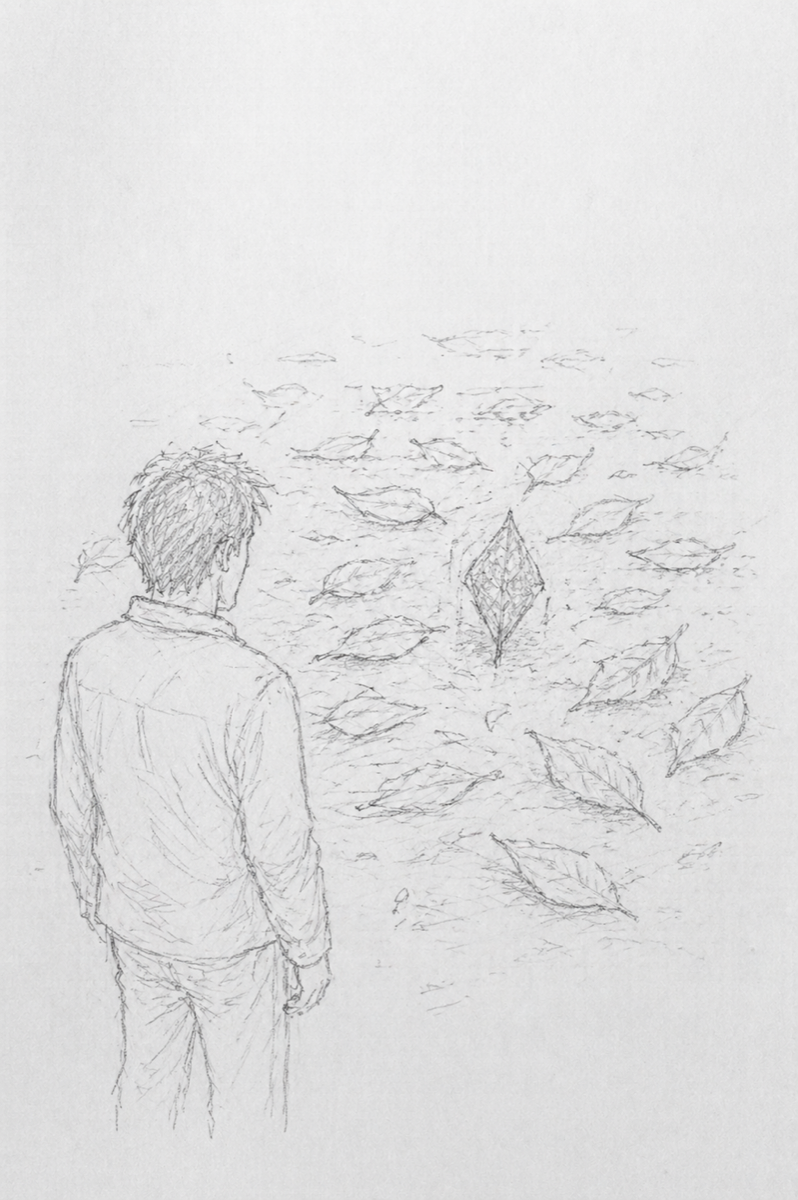
Let's imagine you find yourself dropped in a world where you know that turning over any leaf may lead to a chemical reaction where the dark side of the leaf under light blows up the entire world. You also know there may be an infinite number of worlds. You find yourself in a forest where all leaves are turned over but one. Turning over a leaf has some payout, where the expected gain outweighs the cost of the death. All other leaves but that one — because it is shaped like a diamond — are turned over. There is no reason, mathematical or scientific why people don't turn over diamond leaves. Literally none — and they tell you this. Do you turn it over?
The implicit argument being made is NO — because in all worlds where norms could exist about the rules of turning over diamond leaves — you happen to find yourself in one with alive agents. Even if there is no known rational reason for it — anthropics would suggest that within that norm there is a meta-truth encoding. We are uncertain that worlds without the 'don't turn over diamond leaves' policy have observers. Yet we are certain that worlds with this policy do.
So even if without any good reason we are left with only the shadow of an unprovable to decide around. And so would this rule truly be an irrational dogma? We will not remember to not survive. Or is that rule, the closest moral truth we can know about whether to turn over a diamond leaf would truly lead to our demise? In some sense the point is this — that there is information in our norms which encode the undiscoverable.
We will not remember to not survive.
There is another old parable about a group of monkeys is placed in a room with a ladder and bananas. When any monkey climbs the ladder, all are blasted with cold water, so the group learns to violently stop anyone from climbing. Researchers then replace the monkeys one by one. Each newcomer, unaware of the punishment, tries for the bananas and is attacked by the group — even though the cold water is no longer used. Eventually none of the monkeys has ever been sprayed, yet all enforce the rule. They punish anyone who approaches the ladder because the norm persists long after its original cause is forgotten.
This story is usually a weaponized explanation about the nature of dogma and the irrationality of persistent unexamined belief. But when we constrain this story to the scenarios of Leafland and the Karaoq — such behaviours start looking less naive and more toward a potentially deeper type of rationality. Though, I think the parable may gain its memetic power from having benign consequences compared to that of Leafland or facing a Karaoq.
When the consequences of not following a moral rule are dialed up to the limit — like that of killing all humans on earth — the decision calculus and our emotional response to such stories should change accordingly. For such a limit, I offer one more story — which I think best represents the search of truth at the limit of both power over self and of self-examination.
The Lasting Proof#
Intelligence is running proofs, wisdom is knowing when to not.
The point of this is that 'curiosity killed the cat' may not be a trope that exists gratuitously. Because no agent who heralds truth as its highest virtue, and the pursuit of total knowledge, in a such world, would survive.
But in modernity, descriptive truth and the pursuit of it is held in the highest order. Grok, for example, is quite explicit about the pursuit of truth and knowledge as its prime directive. I conjecture that it can't be held within the highest human regard — due to where I find myself in history. On the long end of a group of survivors whose ethic and doctrine was established on the basis of not doing exactly this. If it worked, and there was a long chain of humans in history looking back at thousands of years of an ethic dedicated to pursuit of knowledge I may have another opinion. But these anthropics — paired with the observation of a galaxy devoid of civilizations we observe suggests perhaps such an impossible proof, like the in the story of the programs, does indeed exist. And we always find ourselves in times prior to finding it.
When I follow this line of thinking all the way down, I then reason that most dangerous things to do may be innovating in ways that pick low hanging fruit. It is so human to think ourselves so smart for being the one person who picks the low hanging fruit and turns over a diamond leaf. This is the danger of hubris. If such diamond leaves did destroy the world. Then the only histories we could ever find ourselves in would be ones with them not turned over. This notion is at direct cultural odds with our habit of deifying, celebrating, and moralizing innovation.
The difference between whether to continue to turn over the leaf, or react to a Karoaq may be the exact line between is and ought in the standard philosophical problem. From Gödel's limit in the laws of mathematics to the rules of nature that make us such fragile beings there will always be something we cannot prove but is, and to try and cross the know-ability threshold pulls the observer past an event horizon. Sub-systems cannot be infinitely knowledgeable, or infinitely descriptive — only equipped with some type of utility function hinting at which boundaries not to cross. For all without such functions are gone.
And the difference between that which we can know to prove, and that what which we never can, is the difference between knowledge and wisdom.