This is not a post-mortem that will teach you what Console One was, why it truly failed. That will only ever be interpreted.
This is mythology and meditation on the consequences of attempting to fulfill one's own myth, spoken as if out but completely and inescapably from within the same psychological patterning it will circle, never quite critique or make true admission of. A castigation of what happens from chasing a story of self the self made, and its folly, while still being exactly that.
It is about me. And so I guess it is about founders. How a founder like myself thinks, why he starts and how he fails. I am not one of one, and I'll leave it to you to pattern this out to whatever type of profile it may help you match and, maybe, understand.
It is defensive because I think attribution bias is all too common. It is self lacerating because I am the owner of a product with failure to launch.
I try to be as candidate as possible, but that doesn't get me off the hook. Of what? You tell me. Hear my story and decide.
Felt Coherence#
There exists a faculty of my cognition which experiences systems and design solutions as felt. A faculty which can look at a problem, a plan, or a proposal of the future, run an audit for coherence, and evaluate it. The rationale or logic it employs I do not know. Only that, in my own experience, its final evaluation is mapped to a pre-linguistic sentiment toward the thing. A bodily reaction surfacing gradients that go from "underlying contradiction" as a discomforting twinge to "perfectly coherent" as a scratched itch. The why is a secondary search, done in the linguistic faculties rationalizing the matter of taste.
Throughout my life I have been wrong in many ways and on many things, but this operation has to date nearly never failed me. In some sense, it has served as the key determinant for my interests, expertise, and behaviours. Rough shapes of coherence I try to chase — and find the blocks in reality that materialize them, or the language to point out the underlying contradiction driving the aversion.
This, along with a little social awareness and a lot of good fortune is what allowed me to a share of relative success at Amazon, getting promoted from an Amazon SDE-1 to an SDM L6 by the time I was 28, and only in 6 years from being out of undergrad.
A Decade Of Plans#
In university, I came across a project called OpenCPU — which was a platform that enabled the deployment of specific programs and their utilization across networked systems and platforms as live RPC handles, making the internet itself look like the substrate under which a distributed programming language could be supported.
I made this my capstone project for my engineering degree, and developed a pre-compilation meta-language which enabled the wiring of specific RPC calls to be baked into the IDE layer, so as to reduce user-facing complexity for cross-platform, intra-system dependencies and infrastructure to the management of verbs. This seemed to make sense, and it scratched the itch — though seeing it deployed at scale, where all the APIs and tools enabled a growing corpus of functions (that being, internet tools), seemed to continue to redraw my attention. So much so that I left Amazon at the top of my game to pursue it.
Throughout and on reflection it was always clear to me the core motivation here was never to be an entrepreneur for its own sake, or to make a billion dollars by any means possible — it was to make that specific thing. For that thing, I gave myself a budget to bootstrap, hired interns, developed a plan, and set off on execution.
It sounds like a tall order, and it was, and I got close.
Monument#
The first thing to caveat is that this is not a conventional startup narrative. And it cannot be understood as reflective of how I operated in teams in larger orgs, or within teams given external directive. Those were not mine to shape, nor could a matter of taste be allowed to intercede with project timelines, users, stakeholders, business objectives, or the input of partners. I specifically purchased time to manifest my particular taste alone, and I consider that maybe that was the primary draw of the vocation.
At Amazon, I was working on some of the most interesting problems in operations, optimization, forecasting, and supply-chain control. I was not in search of any successful company, or leading any successful product. There was no directive to execute other than the itch to scratch. I saved up over the last seven years to do so. I didn't take in any external investment, actively look for funding, or court any co-founders who could risk undercutting that mission. I knew that this was not the risk-free bet. But it was build the thing, or lose it all trying — and having it become another thing in the process would be the worst outcome of all. To build it was the mission.
The temptation will be to read this and suggest I over-prioritized architectural elegance over rolling out and acquiring users. That's a conflation of the underlying objective function. The goal here was always the elegance, transmuted into product coherence when it all fits together. The criticism is apt for running on someone else's dime — and precisely why bootstrapping was the strategic priority.
I can only describe it as buying yourself the space to build a monument to some god you do not yet know, which is probably the purest form of an artist's vocation.
Going Full Force#
After the first year, we (me plus the interns I had hired) had something that worked but needed heavy refactoring: our process-management layer wasn't decoupled from our workflow layer, and our in-house rapid version control needed extensions and configurations that warranted a rewrite.
I had moonlighters building libraries in TypeScript for standard functions which didn't exist at the time (like object serialization, lazy pull streams, and JSON patch). We were going full force. There was no movement in the product space of Replit-like things, so three more years could be afforded to make it work. And then everything changed.
Tidal Wave#
The best analogy I can conceive for being caught mid-way through a deep build of a software-development tool during the advent and rollout of LLMs is just happening to be on the coast for a tsunami. Maybe you hear the sirens. You see it coming. You batten the hatches, scramble, shield what you can, brace, and get swept. Then maybe the wave washes away, but the sirens keep blaring. Another is coming, and they will not stop.
The industry shifted attention and focus from general software infrastructure to build tools, IDE improvements, and means to apply intelligence APIs to auto-wire, auto-provision, and de-obfuscate the development experience. Programming-language mechanics themselves no longer needed to be known — so the same should go for build tools. Not only was the central value-add of the orchestration framework diluted under the immediate, attention-grabbing capabilities of an AI that automatically builds Pong — it became much less necessary.
Our niche market — the one that permitted the runway for a bootstrapped vision — was instantly flooded by venture-capital-backed teams of experienced move-fast capitalizers with accomplished acquisition histories, and architects optimized on getting AI integrated quickly to transform the developer experience, whereas our mission and build were centered on cohesion. Beyond this, all the variables that underpinned the plan were now sliding toggles of massive probability bands. What was distressing about this was not actually that what we were building wouldn't matter anymore. It was that the probability we would build it second, or third had dramatically escalated.
I had been convinced for a long time that the convergence of the entire programming faculty into an API-managed SDK was the ultimate endpoint; the problem was that getting there second felt like death. Or, the curse of Cassandra: being right and misunderstood until you can only be interpreted as either a copycat or a replica of an existing innovation. This directly interfered with my own internal reward map. I had less a desire to profit off the object of significance I was attempting to manifest than for the credibility obtained for its invention itself. And that was brought into compromise with the notch dialed up to eleven and all my cards already on the table: I had physically moved to Mexico with my wife under the condition that I would work here for years.
Simply going back to industry was not an option. The saving grace appeared to be that, for the problem of abstracting the development workflow for APIs, I had a unique head start. And that principal justification was all that was needed to keep going.
Here is the exact cut of the document I used as the principal arguement, to myself and team.
Holding the Line#
I flirted with the idea of getting help, though I never actively sought it. Interested folks I knew socially entered orbit, and partnerships were discussed. One came with a significant (6 figure) capital investment, which I turned down on the basis that the vision would likely be compromised.
Another came with a group meeting with a popular Canadian VC who recommended I throw the project away in order to build a GitHub plugin. That may have been sound advice to get investment. For a long time I was bitter about this. But it may have worked — for the fact that GitHub plugins are the type of things that get invested in. Then I remember the claim cuts both ways: Console One may have also worked had that investor invested at the time they did. In either case, it was noise.
I put together a thicker team of top-tier SDE moonlighters and a thirty-page design plan attached here built meticulously to materialize the goal in under a year, and continued the bootstrap, upping my own budget out of pocket to hire a team of five interns on quarterly rotations in the process.
Now, at this point it may seem naive or irrational to continue, but before I started at Amazon in 2015, I was in a similar circumstance. Wanting to build the thing, being worried about getting distracted, relenting to give Amazon only a shot for a few years because of external (familial) pressures — and then finding I had blinked and seven years had elapsed. And still receiving the call by reality itself to leave and build it.
Grip and Rip#
A year and a half after starting, and in what felt like the final moments the project had to stay alive, I got the first end-to-end version of the system completed, in an execution run that literally had me in tears of relief.
By November 2023, the system was deployed as a self-managing distributed process-execution substrate. I could point it at a URL, have it use our custom semantic-analysis engines to build a recursive map of the front-end (and even back-end, if available) codebase, which the kernel could map across a set of distributed processes; document the system using an AI algorithm I built to generate initial notes, exchanging them in a two-phase pass; and then re-deploy a copy, or replica, of the system within our network. It was called 'grip and rip'. I thought we had a winning recipe and would be able to get investment for it, and use that money responsibly.
I first went to friends and family at a discounted valuation and accepted capital from those who could afford to risk it, and we built a website for the product we were all but guaranteed to ship.
A Replit-like system with built-in AI functionality before anything of the sort existed. We were off to the races and built it into a product that by March 2024 we could use as the primary console and IDE for bootcamps we set up to run at local high schools and teach them to code.
It worked well, with zero bugs in the first two sessions, until the third lesson. Deployments were slowing and cancelling.
At first, not a big deal. Friends-and-family funding closed, and the first circuit of highly interested VCs spurned us — two years after the start of the project. At this point, the excitement could have unravelled me, and nearly did.
The Heat Shield#
The small deployment failures ended up being the heat shield that destroys a rocket on re-entry. Provisioning and bottlenecking use of our system required structured intercepts at the container layer for external API calls, and CPU cycles or program ticks.
The system was built for deployment on AWS Lambda, and resource-provisioning guards around the central operating kernel were quite literally structurally impossible for its deployment packaging on AWS Lambda. Though I say this in matter-of-fact terms, it came after a four-month, 120-hour-a-week search of nearly every alternative pattern or re-architecting avenue I explored as near-feasible. At this point, it felt as if reality itself started running protocol suffocation for any dreamer that gets made into Icarus.

Concurrently, the complexity of complexity started killing our demos, and the interns could no longer ship incrementally without a system-cleanliness overhaul. I was gaunt — flipping between news articles announcing 'new AI auto-code tools that run autonomously' as ground-breaking; trying to fix a kernel that was designed for the wrong problem and solvable only by an engineer-partner I didn't have; and standing in front of the system at product demos for investors, watching it break from the latest patch for the previous break.
The months I lost trying to fix a critical architectural bug changed the landscape from 'no-code' IDE as a conceptual artifact to something for which there were already five blazing-hot market participants. We had reached out to thirty VC firms on the same terms as discussed with excited Canadian investors in April and were met with crickets. I tried to articulate the more core substrate work we had done, the importance of our self-deploying kernel, but that fell on deaf ears. I had yet to learn how the curse of knowledge muddies clean communication. I had yet to learn what VC's look for.
By November 2024, every time I opened my phone or saw a media headline of a new AI-automation tool that was groundbreaking, I felt literal barbs in my chest. So much so that the courage to investigate their feature set and determine a structured response had to be outsourced. That was one tactical decision I regret. I hated feeling like I was right, knew what to do, and betrayed by the universe for taking the risk to actuate it.
Days melted by — VC calls where the system was passed over because of some acclaimed problem with the space itself. On one call, the only structural objection was the colour of the system. On a few, demos broke as a result of benign procedural failures I could have detected had demos been the only priority. But I was always working on the problem underneath.
It is easy to call this a critical engineering failure that should have been caught or simplified around. Maybe. The problem was that the project and timelines were allocated such that deployment — not LLM orchestration or rapid rollout under the risk of competitive response — was the assumption baked into the system at an architectural root. I knew I would never have started off with this particular build had I had the fortune of knowing the tsunami was coming. But I didn't.
The standards of a complete product skyrocketed; the number of concurrent features required to be both novel and competitive — and the timeline to market — all shifted. Along with the information advantage I had as a solo developer who knew how to do cheaply what others couldn't figure out, was also removed with AI commoditizing of standard integration work.
Waves crashing on the beach. Heat-shield failures blowing the only exit to atmosphere.
Pressure, Diamonds, and Pipes#
I responded by leaning into the one thing I knew I certainly had that no competitor did. Constraint. I worked backwards from every system concern to develop a concrete view of distributed computation and the primitives required to materialize the system within the engineering cycles we had — which had reduced to me and a single full-time college graduate remaining on payroll.
At this point, rubber-duck analysis was limited to long-winded conversations with AI systems themselves, because the constraint landscape was so densely populated that ramping anyone took days of structured discourse.
At this point, it wasn't broadly understood how dangerous using an AI for idea validation could be, and I was operating under a counsel which implicitly posited that superintelligence itself would be the outcome of the kernel.
The outward collapse was matched with an inward emotional grandiosity which, though it was immature, wasn't necessarily built on wrong premises. Any path to a distributed computing substrate which would act like a global computer required the primitives identified. But being able to see the thing, and grind it into metal, are two different categories entirely.
Feeling a click and actually clicking it do not come hand in hand. Knowing what will happen does not mean you have the agency to be the one to make it so.
This is the second tactical error I made. Despite a capacity to feel the shape of the architectural end game long before proven, I was warned by a mentor and ally that it wouldn't be enough to win in the world of entrepreneurial constraints. Not because I would be wrong, but because money, time, and x's and o's may run out before the end state could be cohered. And he was completely right. If only that statement was a system, maybe the words would have stuck. I understand as much now.
By March 2025 I had the entire problem of building a JIT compilation engine across a distributed computing substrate mapped and laid out for review by another principal PE at Amazon, who, after several days, concluded that yes, our analysis and formulations of solutions were correct, and yes, our idea of what to do made sense, but no — he wouldn't continue helping us pursue it. What does that mean?
It means we had fallen victim to complexity's complexity, and to the economics of a world standing between the chased-after coherent solve for agents, agentic systems, and the substrate — without the resources at our disposal to be the ones to solve it. This landed like a hammer.
Metaphysical Collapse#
I had clearly on some level overidentified myself with the project, and so on some its collapse meant losing something more to me. This section only contains a self report of its psychological impact. For those uninterested, you can skip to 'Picking Up The Bootstraps'.
I had laid out my own self at the behest of reality to accomplish my part in fulfilling the vocation, and reality chose to betray, punish, and humiliate me for that at nearly every turn.
At the time, I had chosen to direct the anger at all those who heard our pitch and elected to write us off for status reasons rather than first-principles ones — but it was a masked grief of my own loss: Some metaphysics I hadn't defined or wouldn't admit had me chasing things as if there were a god, karma, or the manager of the simulation itself to come down and put me in good graces for my alignment to virtue. And maybe, no such force exists.
This was more shattering than any economic loss or social humiliation. The idea itself that maybe chaos is simply chaos, and having pure intentions a dedicated heart may not lead to rewarding outcomes. I would have framed this, at one point in the fall, as a narcissistic collapse — but that also implies a degree of shame which I am now, too, past — seeing it as the other side of the coin to pride in the object of one's own self-importance.
Once I got over the idea that I am anything more than one of 8 billion flawed humans, this lesson settled into a universal empathy and solidarity with the rest of people that I don't think I would ever have had before. What followed was an understanding of how real and vapid my own survivor bias was.
That lesson, in and of itself, hopefully, broadened and deepened my capacity for love. And hopefully will help me transition from being Raskolnikov prior to his crime and punishment to something of someone who need not narrate themselves as anything after.

Picking Up the Bootstraps#
Despite the month-long, possibly nervous breakdown, of February 2025 — which I now consider the exact moment I became an adult — I still needed to go on. I was still year three of four in Mexico, and needed to pick myself up by the bootstraps and try again. We decided to build a simpler iteration of the tool that ignored the distributed-systems problem on the outside and settled into an information-management apparatus for agents themselves on users' local desktops: it leveraged our experience and existing solutions, and sidestepped having to rebuild straight into distributed infrastructure.
The challenge at this point was not the actual code. It was seeing the same underlying problem within the problem — the need for a self-updating computation kernel running a local instance within individual user nodes — and, even more substantially, the loss of belief that reality itself would reward me for any more work I did toward those ends.
At this point, I had written around 500,000 LOC of original solutions spanning parsing, compilation, event sourcing, version control, process management, distributed tool-chains, multi-tenancy constraints, and runtime-evaluation sandboxing — the list goes on. Each solution worked in isolation; none worked together, because that was the problem within the problem.
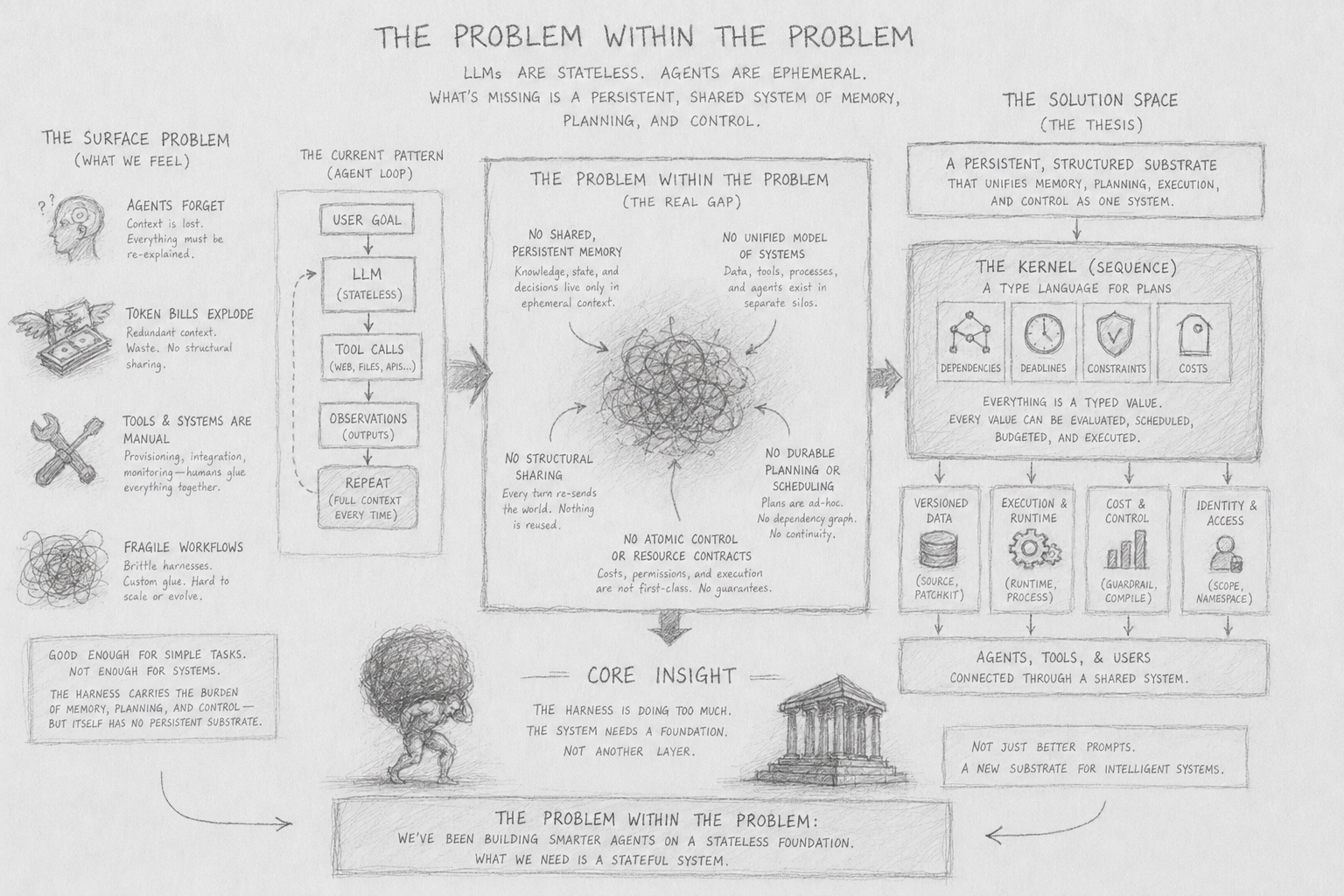
I spent more and more of my brainpower writing a novella, in after-work cycles, focused on mythologizing the AI problem — which I would later release anonymously as an act of re-integration, catharsis, and attempted stewardship of the culture of modernity toward something slightly less self-concerned.
The Struggle of the Struggle#
Structurally, humiliation itself became the primary barrier between me and the willingness to move things forward on the business front. Heart barbs day in and out. Forgetting who I was, what I was trying to do, and reasoning myself to be someone I'm not. Losing the battle between the commonplace perception of a startup founder who doesn't roll out a project and what I knew I had set out to do — which felt itself a feat for Atlas.
The principal problem became not having tried it, nor being right but slow, but having taken that investment and risked others in the pursuit of something which — until that very moment of excitement — was properly shielded as a personal endeavour. I could no longer look at things with a sense of pride and virtue for having the courage to chase my meaning when the resources and futures of others were tied into it — like the employees I still had on payroll, who took massive wage cuts because I knew it could be done.
Such an experience sorts out very quickly those who care about you and those who don't. And to those who supported the gambit, my heart opens in a way that's difficult to describe. I spent the next year trying, if only for that, and to pay penance — but penance itself isn't shaped like a system that clicks, and so the grind became truly that. We shipped StoryLens as a slimmed-down version of what could be best described as a local, harder-to-use Claude Desktop — and then got nerfed by reality again when Claude Desktop released a week later. Excited enterprise prospects filtered out of the calls.
We shifted to the self-scheduling problem only to get beaten by OpenClaw weeks later on the novelty front. What remained was a lot of hard problems demonstrably solved by a team too thin to execute on the breadth of our intended vision, no particular niche we were familiar with, and a habit of familiarity with solely the domains that border on the impossible. The final leg shifted to synthesis.
Codification of the entire domain space into a single kernel, operationalized in the final product and production system, SharedOffice — a memory substrate and reactive-orchestration layer for agents and the people who use them. A much more modest product than I originally set out to build, with fewer users than I expected and no more itch to scratch.
What We Want, Need, And Can't Even Qualify#
And it's now the end. Did I fail? If a monument is built for a god we know not, and in that building we learn its nature, ourselves, and the winds and rains that slam the rock and leave the imprint of chaos on our statue's face — does that change the act itself?
For me, it didn't meet the goals of its ambition but it did serve its purpose. For those who invested, I will be finding small ways to pay back their votes of confidence for years to come, despite having taken the exact swing I promised. I understand the problem, system, people, and the dimensions of life now in the kind of way that I needed but wouldn't ask for. Was I first? No. Claude and Anthropic were. The design of the core system is remarkably close in concept to the TypeScript libraries developed for Console One — but they made the one taste-based decision I missed clear as day: to have the apparatus run locally from the jump. And being wrong about that makes me happy.
And honestly, I'm not even sure if that version of me should have won. It is the part of me interested in zero-sum games. Reality itself may not have benefitted from him being in charge. That exists, though it tempered. It feels like the grand irony is that this current version of me is someone I would argue can handle the responsibility of stewardship — the cost of wisdom often coming due only upon leaving the situations one could deploy it in. For this reason, I write.
This psychological shift to a more moral focus may just be a cope. Maybe. Neitzche would say as much. But I also think the reduction of a complex circumstance's success to an individual character attribute or flaw of myself is both attribution bias and a consequence of a central moral failing of our time. Affect to common culture and public discourse is over represented by those with the survivorship biases of success and a structual dis-incentive to acknowledge its implications coherently.
On Regret#
There are a million tactical decisions I could have revised, but would they change things? I don't know. I stand by a large number of the calls we made. I don't know who could say what the better decision would have been. Maybe the scope was literally too big for any person to finish. Maybe not.
Does it seem like my financial and professional circumstances would have been more likely better had I scoped out, focused on immediate working use cases and a niche customer group to consume the tool prior to building the whole thing? Maybe.
I know that what I learned the hardest is that the worlds of entrepreneurship and intrapreneurship, especially in Amazon, are worlds apart. At Amazon, being right, detailed, thorough and data-driven gave power. Entrepreneurial success (with investors) I think is much more determined by who you know, who you have to leverage, and 'social status' — in that sphere — over and above literally doing anything.
Instead of pretending to change the past, I'll explain what I hope I would do differently if starting a new and different project in the future:
- I would not walk away from a job pre-investment again, because it would only be that way if I couldn't put together a sellable story to get people on my side.
- I would also move back to a tech hub for proximity to connections, even if I worked from home, for no other reason than having better luck to be at the right place, at the right time.
- I would have slept more, maintained more lists.
- I would have cultivated a stronger and more well-suited network, and learned better skills for doing so. That is certain.
There are other things I could say, smaller idiosyncracies, not worth mentioning beyond explaining how I hope I am becoming the type of person who doesn't have them.
The Stories We Tell Ourselves#
In hindsight we may rationalize our failures, or retroactively assign meaning to what may ultimately be benign chaos. Say that the suffering was worth it for one reason or another. I doubt I want it to have all shaken out exactly like this, but the timeline is determined. To imagine it otherwise, for nothing more than cultivating a little more courage to do the right thing next time, seems like self-flagellation and an attack on one's own serenity.
I'll simply refuse to accept the easy, self-deprecating frame that positions this outcome as a moral failure or a particular gap in insight or capability — and I'll argue for it. Not because I can prove that — I cannot falsify any real explanation for this sequence of events — but because where nothing can be tested, all that is left is to decide the most useful story to tell myself.
That is the hard stance I have to take, or else the easy interpretation will rewrite the value from this effort that can still be obtained: If the conclusion actually was, I was too stupid to pick a problem I could solve, or to know I couldn't solve it. Then done, case closed. All critiques are now silenced and ownership is taken. But who actually benefits from thinking that way? That would be like closing an essay on "How to grow to 6 feet tall in adulthood" with the claim that I am 5'6" and know nothing of the sort of growing to 6 feet. It works to discuss things as if they are controllable, even if they never were: Maybe they will be next time.
If I would to conjecture a summary: think the real reason is that I could build, not sell. I contempted investors and others who could probably see this clearly for not giving me the resources to build something that would 'sell itself'. When those resources didn't show up, I tried to build myself out of a hole which bad luck and timing were making deeper by the day. Investors couldn't distinguish my build from any other 'auto-code' tool in, now a massive pile. Indexing on sales was rational. My inability to sell and the size of my network, was also hurting my ability to attract a partner I would be willing to conceed so much the business I had sunk my life into, over too. Which I had tried for, un-succesfully.
Our Vocation#
The outcome may not be what I wanted, but the universe has a way of knowing how to show us what we don't know.
And for that reason, I still follow the feeling of coherence. The click. Though now I know it doesn't mean that the ends to which it points are easy to do, or rational, just possible. As in, it is possible for Atlas to lift the world. Or for someone to lift the sword from the stone. We just don't know if we are Atlas, or Arthur, until we try. And to find out, sometimes, is the calling itself.
Having the courage to try to lift the world is one thing, but to keep lifting when muscles rip and all of you wants to walk away from the pain is another.

Deciding to try is not what I look back at and think took courage. Real courage was in the keeping of deciding every day to do the hard thing, the painful or embarrassing thing, for only faith to an earlier self's convictions and the integrity of your dreams. Because after enough rejection, the chance of an immediate variable reward no longer spikes dopamine. Discipline, not excitement, wins out. And discipline requires always the courage to be temporarily uncomfortable for the prospect of a higher future baseline. These little moments are the ones we lament and deride ourselves for. When knowing better. There were moments I lacked that courage, then days and weeks. Each moment was different, small, and uniquely personal. I can't describe them, but they are truly why it didn't work — in the only way it matters to regret.
Your Directive#
After it all, what I can only certainly leave someone with is this: Do the hard thing you know you should be doing. Do what you know is right. No matter how it pans out after that — there are no regrets which can be had.
With love, A